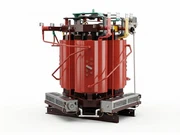
Introduction To Power Transformers
Feb 02, 2026
A transformer is a static electrical device used to transform alternating current (AC) voltage and current to transmit AC electrical energy. It achieves this transmission based on the principle of electromagnetic induction. Transformers can be categorized by their application into power transformers, testing transformers, instrument transformers, and special-purpose transformers: Power transformers are essential equipment for power transmission and distribution; testing transformers are used for withstand voltage (step-up) tests on electrical equipment; instrument transformers are used for electrical measurement and relay protection (PT, CT) in power distribution systems; special-purpose transformers include electric furnace transformers for smelting, welding transformers, rectifier transformers for electrolysis, and small voltage regulating transformers.
A power transformer is a static electrical device used to transform an AC voltage (current) of a certain value into one or more voltages (currents) of different values but with the same frequency. When AC current flows through the primary winding, an alternating magnetic flux is generated. This alternating magnetic flux, through the magnetic conduction of the iron core, induces an alternating electromotive force (EMF) in the secondary winding. The magnitude of the induced EMF in the secondary winding is related to the number of turns in both the primary and secondary windings; that is, the voltage is directly proportional to the number of turns. Its primary function is to transmit electrical energy; therefore, rated capacity is its main parameter. Rated capacity is a conventional value representing power, characterizing the amount of electrical energy transmitted, expressed in kVA or MVA. When the rated voltage is applied to the transformer, it is used to determine the rated current that does not exceed the temperature rise limit under specified conditions. A more energy-efficient power transformer is the amorphous alloy core distribution transformer, whose greatest advantage is its extremely low no-load loss. Ensuring the optimal no-load loss is the core issue to consider throughout the design process. When arranging the product structure, in addition to considering that the amorphous alloy core itself is not subject to external forces, the characteristic parameters of the amorphous alloy must be accurately and reasonably selected during calculations.